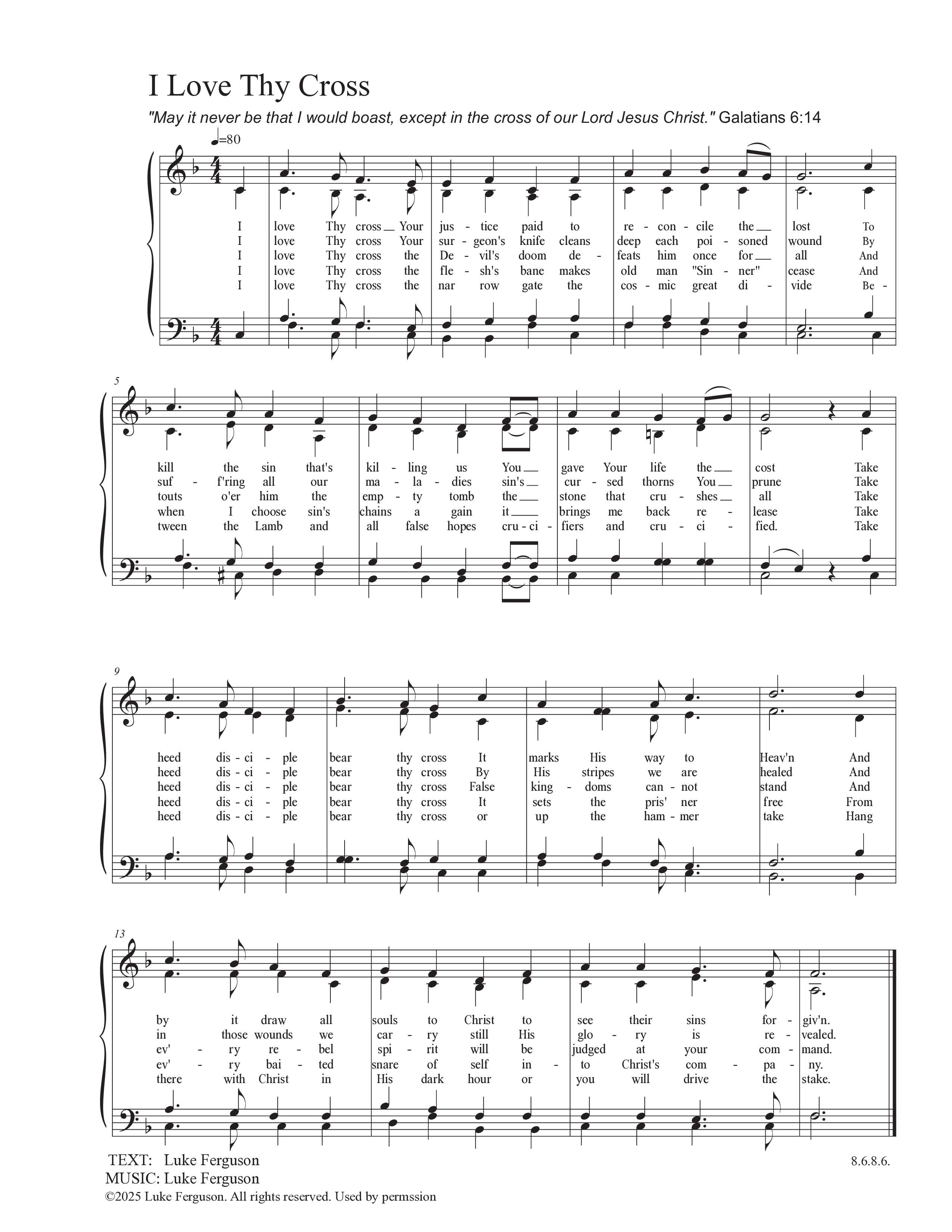
Day 6: Verse 5—For the Uncommitted, Polarization

I love Thy cross, the narrow gate, the cosmic great divide,
Between the Lamb and all false hopes, crucifier and crucified
Take heed, disciple, bear thy cross, or up the hammer take
Hang there with Christ in His dark hour, or you will drive the stake

There was a time for Christian music was best suited for soccer moms in their 30s. This verse bucks this trend. The song we have been singing together presents a stark contrast, an ultimatum, a polarization just like Jesus did. One cannot get away with merely hearing lovely music and thought-provoking words when discussing the cross. It has to be brought back to its simple, inescapable destiny: you are either on your way to hanging on the cross, or to hanging someone else on it. This is the offensive message of the Cross.

For those who reject this notion, I invite you to think it through. First off, humanity is fundamentally sinful, and on its way, hopelessly to a rightly deserved death because of our rebellion against God. Whatever the state of our hearts, we find this state of heart in the people recorded during the week of Passover, all coming together to put Jesus to death. Whether we are insecure (Pharisees), curious but distracted (Herod), interested but uncommitted (Jewish palm-branch-wavers), committed but cowardly (disciples of Jesus), politically threatened (religious leaders), following the crowd, (Barabbas release-callers), interested in control and keeping the peace (Romans), or whatever else their hearts may be, all of them together joined with one accord to put the Son of God to death. That makes each group, by default, part of the “crucifier” camp. Apart from the grace of God, which of these camps would you belong to? If you can’t find your camp, look again.

Only the repentant thief on the cross chose to hang there with Christ in His dark hour, rather than continuing to hurl abuse at Him.  He showed us what it is to hope on the Lamb of God, and no false hope. He is the one who was promised paradise. “Up the hammer take” is simply a call to make a clear distinction: don’t kid yourself into thinking that if you’re not carrying your cross, you’re somehow innocent of the blood of those who are being put there still today. For testimonies of those carrying their cross currently, I bid you check out persecution.com, and get the monthly magazine for regular reminders of what following Jesus, carrying your cross, looks like.

Remember, Christ said that the way is narrow that leads to life, and the gate is narrow, and those who find it are few. How many of the numerous “Christians” today are walking this narrow path traced by the groove left by the cross beam trailing behind Jesus? If you are feeling convicted right now, remember what Jesus prayed when He looked out on those who had put him on that cross. “Father, forgive them. They don’t know what they are doing.” Receive His forgiveness, repent to wherever you last dropped your cross of total surrender to following him with your whole life, pick it up on behalf of your enemies, and follow Him.

Reflection Questions:

  • Do you believe there are only two kinds of people in the world, “crucifier” and “crucified”? Why or why not?
  • What is the difference between laying your life down for Christ and laying your life down with Christ?
  • What is one thing in your life that makes it impossible to pick up your cross and be ready to lay down your life with Christ?

Day 5: Verse 4—For the Fleshly Christian, Liberation

I love Thy cross, the flesh’s bane makes old man “Sinner” cease
And when I choose sin’s chains again, it brings me back release
Take heed, disciple, bear thy cross, it sets the prisoner free
From ev’ry baited snare of self into Christ’s company

“Now I say this, brethren, that flesh and blood cannot inherit the kingdom of God; nor does the perishable inherit the imperishable.” 1 Cor 15:50

This is not to say that we will not have physical bodies in the New Heaven and Earth, but saying rather that all of our old life, the life of the “flesh,” the old man, must pass into death, so that God can resurrect that which resembles His new creation patterned after His Son. This entails the casting aside of everything that is less than Himself or more than Himself, which we might try to squeak through the eye of a needle. All of this is the flesh’s nature corrupted by sin, and it requires an existence living in death to self so that we may have renewed life in the inner person by the Spirit.

“He who suffers in the flesh has ceased from sin,” said Peter (1 Peter 4:1.) This does not mean that if our bodies hurt that we somehow are more holy or righteous, rather it means that sin is grown in us from our old man which arises as we live in this “body of death” Paul bemoans in Romans 7. It’s not like sin is only on our outside, but it’s already a traitor on the inside, ready to raise and lower the drawbridge to let in evil things of the world and the Devil. But the cross deals him a death blow: everything the flesh would enjoy, He brings to the death of self-denial, which is coupled with the command to take up your cross and follow me. The Spirit desires against the old man’s fleshly desires, so that you do not do the things you please. (Galatians 5:17)

Now, does this mean we should never enjoy the good things our bodies enjoy? Certainly not! Otherwise, the flesh would take the opportunity to glory in its asceticism. Instead, be thankful and open-handed with the Lord in trust, fully surrendering every good and evil thing to His purposes. That is what carrying your cross looks like.

And for those who struggle with addiction, the cross gives you liberation. You are addicted because there is some area of your life that you have tried to depend upon, replace, or overcome by your own power without surrendering it to Jesus for Him to put it to death. Everything in your life must be laid on the altar of total surrender to God, “nailed to the cross,” and “put to death,” or else it will become an idol. Obviously, I’m not talking about people being killed, but rather that part of us which elevates any person or thing in devoted importance above God, rather than thankful receptivity from God—that part of us being put to death daily. As we do, we discover freedom from every snare of self so subtly baited for our own good, and we discover Someone who walks with us unfettered. Someone who wishes to run barefoot with us through the meadowlands of sunshine. Someone who knows us and wants to be known by us. This is the company of Christ that all Christians can keep if they walk by the Spirit, not carrying out the desires of the flesh. (Galatians 5:16) Remember, for the Christians, the only shackles are made up of our own bones and ligaments, and the snare’s bait—that which we refuse to let go.

Reflection Questions:

  • What area of your life is “me”-centered?
  • What is an aspect of your life that takes control of your thoughts, emotions, or plans independent of God?
  • What is keeping you from surrendering that to God completely right now, and thanking him for it instead?

Day 4: Verse 3—For the Tormented Christian, Emancipation

I love Thy cross, the Devil’s doom defeats him once for all
And touts o’er him the empty tomb: the stone that crushes all
Take heed, disciple, bear thy cross, False kingdoms cannot stand
And ev’ry rebel spirit will be judged at your command

The cross is the emancipation of all who embrace it. Growing up, one of my favorite songs was “Early in the Morning” by David Meece, an anthem of Christ’s victory over the Devil at the cross. This verse takes a victory lap over all spiritual forces in league with the Devil, and is meant to give courage to any intimidated by his schemes.

The Devil is a defeated enemy who keeps raging and destroying as much as he can on his way down. Anything he can do to dim the lights on Jesus’ triumph, he will do. But any devilish spiritual power, whether in heavenly places or roaming around, that seeks to undo us needs to be reminded of the victory in the cross of Christ for all of Jesus’s little brothers and sisters.

That being said, it is no guarantee that the evil one’s torment or oppression can be undone simply by verbally invoking Jesus’ name or holding up a wooden beam. (See Acts 19:11-16) This is no magic trick. This is about authority. Jesus’ death on the cross and subsequent resurrection are what defeat the Devil’s most powerful weapon and buy back all the faithful dead who have waited for their redemption in Him. He now has all authority on Heaven and earth, and this authority He extends to His followers in the world. The world, still under death’s power, did all it could to seal a rolled stone to prevent intervention. Still, just like the rejected stone becoming the chief of the corner, so the attempted seal of Christ’s entombed fate has become the final broken seal of His victory over that which holds the world in its clutches—over death itself.

In light of Jesus’s victory on the cross, there is only way to guarantee that we do not fall prey to the devil’s schemes, or oppressive tactics: we carry our cross with Him by totally surrendering ourselves in trust to our wise and loving Father. The Cross of Christ is the only thing the Devil cannot beat, and it protects the Christian from the Devil having any foothold. The Evil One can only gain a foothold in any aspect of the Christian’s life that he or she is trying “to save,” but the cross is where the Christian loses their whole life for His sake, and find it in the resurrection.

The victory is assured, because no kingdom divided can stand. And any kingdom divided from the truth has already forfeited any lasting presence. This goes for earthly kingdoms too reflecting the spiritual forces in high places that influence them to elevate themselves against the Most High. The Cross stands at a level place for all humankind to be redeemed in the midst of mountains of pride creating valleys of poverty. And these rebel spirits will be judged when their time is finished, because of the outcry of those of us who remained faithful to death. The more we share in carrying our cross, the more we can rightly step into the full authority of Jesus Christ, won over sin, death, and the devil. It’s already ours in Christ if we will walk in the power of His Spirit, which Jesus committed to the Father with His last breath.

Reflection Questions:

  • What powerful forces of evil in the world today do you see shaping the current state of affairs?
  • What are some areas of your own life where you sense the Evil One at work to undo God’s restoration of all things?
  • How does the cross answer these?

Are you ready to carry your cross by surrendering all devilish footholds to obey God?

Day 3: Verse 2—For the Broken Christian, Restoration

I love Thy cross, Your surgeon’s knife cleans deep each poisoned wound
By suffering all our maladies, sin’s cursed thorns You prune
Take heed, disciple, bear thy cross, by His stripes we are healed
And in those wounds we carry still, His glory is revealed

I hope to shepherd the hurting with this verse and the Cross’s restoration. The profound significance of the cross’s impact is vitally important to the Gospel because every one of us has been wounded beyond our own repair, and not one of us has been wounded as deeply as Jesus. This is difficult to accept, especially for those who are still going through the anger, depression, and soul-sickness that our wounds bring. Here, I hope to offer you a light for your journey in this dark tunnel.

When Jesus died upon the cross, He took upon Himself all the brokenness and wounds of all the world—the verbal, emotional, and physical abuse of close and distant enemies who were supposed to love him. In a moment in time, He showed what the Father has endured for millennia. The more you look at the grotesqueness of what He endured there, the more comfort there is in what you endure. But like those bit by the serpents in the wilderness in Numbers 21, the only way you can be healed is by choosing to look up at Him on that cross, and look hard.

Every blow He took was for your healing, and the healing of the ones who wounded themselves by hurting you. He experienced the depth of life’s sorrow and loss to be with you in the depth of your own loss and sorrow. He did not cheapen it, like some who pass over the cross to the resurrection. He didn’t let what He experienced be forgotten. His glorified body still bore the marks of His betrayal, His agony, and His humiliation. But now victorious, these scars bear a greater glory in life eternal. His story is immortalized not only in our memories but in His own body at the Father’s right hand, interceding for us still.

And for the suffering to come, He also offers greater grace. Sin’s cursed thorns tear at every aspect of our lives—relational, physical, mental, emotional, spiritual, but they are no longer rampant or unchecked. There is a bottom to the abyss from which He arose. There is a refuge in the thicket where the animals hide in safety. There is a cleft in the rock. And because Christ’s suffering came to mean so much forever, there is joy and hope for us that our stories will result in something greater, something more truly glorious that presently makes no sense at all. But this can only be if we are willing to commit our wounds on our own, our suffering for others’ sake, our unconscionable memories to the Lord, and trust Him to bring about something good. As Joseph told his retribution-fearing brothers, “As for you, you meant evil against me, but God meant it for good in order to bring about this present result, to preserve many people alive.” We won’t be told why, but we will be shown His glory when we see and touch His wounds in person at last. Until that day, let our hearts be kept tender by recognizing His suffering, so we can recognize and sympathize with others in their suffering, so that they might see the glory of total trust in Him ablaze in our still-beating hearts.

Reflection Questions:

  • What have you suffered that you feel like nobody else can understand?
  • What makes it hard to look to God when you’re hurting?
  • In what ways have you seen God bring good out of the terrible things you have suffered so far?

Day 2: Verse 1—For the Private Christian, Justification

I love Thy cross, Your justice paid to reconcile the lost
To kill our sin that’s killing us, You gave Your life the cost
Take heed, disciple, bear thy cross, it marks His way to Heav’n
And by it draw all souls to Christ to see their sins forgiv’n

The first verse is about justification—the jewel in the crown of Reformation Theology. It is at the very heart of the gospel itself and the most notable and essential work of Christ on the cross—the payment for our sins and the making us right before God by grace through faith. Any song about the cross would be replete without this glorious world-turned-upside-down significance of this singular historical moment. “He Himself bore our sin, in His body on the tree that we, having been dead to sin, might live to righteousness.” Romans 3 is a wonderful part of Paul’s theological treatise on how this works: from our sinful estate to God’s free gift of salvation in Christ Jesus. The verses I will highlight here are verses 23-25, “For all have sinned and fall short of the glory of God being justified as a gift by His grace through the redemption which is in Christ Jesus; whom God displayed publicly as a propitiation (or valuable sacrifice) in His blood through faith.” This means that there needed to be a sacrifice made to pay for the sin causing us to fall short of His glory, and Jesus willingly offered Himself as that sacrifice for all who have faith in Him.

He had to take our sin into His body to become sin for us, so that the sin which kills us (Romans 6:23) may be put to death. And no one could pay that cost or can pay that cost except the one through whom, for whom, and to whom are all things: Jesus Christ, God incarnate. What a wondrous and glorious mystery!

The implications for a Christian for why they must carry their cross are these: Jesus left His people here on earth to carry their cross and follow in His footsteps so that:

  1. People could see Jesus’ work in a fresh and living way in His people, in whom Christ is formed.
  2. People can see that true freedom and release are not the absence of suffering, but fully entrusting oneself to the One who makes a dry-land pathway through the river of death.
  3. It is in dying daily that we are daily reborn to eternal life until He comes again.

There is little in this world more distasteful than a “Christian” who is unloving or selfish. If only we could learn to lay down our lives in love for others the way Jesus did on that cross for us. Christ indeed showed us the humble way of total surrender to the judgment of the Father, not for His own sins, but for the sins even of His enemies. This Love is the only love that breaks the power of sin and death to blind people from recognizing the God in whose image they were made. A Christian, by the Holy Spirit’s power, can love like this, and by his or her love draw people to experience the transforming love of Christ. Perhaps as more Christians do this, the less deconstructionism, church-hurt, and hypocrisy we will hear about, and the more baffling, unexplainable grace will draw souls to Christ so they might see their sins forgiven in Him.

Reflection Questions:

  • Tell the testimony of how the gospel has changed your life. Then check: did it include your sinfulness, Christ’s sacrifice, and your acceptance of Christ as your Lord?
  • How have you encountered Jesus in the world? Through whom have you experienced His love?
  • How might your relationships with others be impacted if you lived sacrificially for them, instead of for your own sake?

“I Love Thy Cross”– One-Week Devotional: Foreword

I want to be careful not to be too careful in this devotional. Not only is the message of the cross offensive and foolish in man’s eyes, but any attempt to make it otherwise is offensive and foolish in God’s eyes. I also don’t want to explain too much behind the artwork, depriving this form of its potency. Still, I think some guided reflection can be helpful both for those ready to pick up and carry their cross and those not prepared to do so.

Furthermore, one of the purposes of this song is to be an anthem for the body of Christ, the church, to sing as one. In the poem, there are five problems that afflict the body, keeping it from cooperating to carry something as uncomfortably heavy and deathly humiliating as a cross. While in each verse, the cross answers a different issue, every believer needs the reminder of these aspects of the cross. I hope that this will inspire more verse and song written about the Cross of Christ.

The first verse addresses the tendency to keep one’s Christianity private and personal to the individual. It calls the one not bearing fruit of loving relationships to meditate on the significance of justification and to walk in Christ’s steps by laying down his or her life each day so that others may know Christ’s love through him or her.

The second verse addresses the stumbling block of feeling too wounded and broken to bear any cross on anyone else’s behalf. It calls the one who feels this way to recognize Jesus’ restoration that He accomplished on the cross, that His glory is revealed in brokenness.

The third verse addresses how many feel the torment of demonic oppression ties their hands. For the one who feels too bound up with spiritual torment to carry the cross, this song calls him to embrace the emancipation of Christ’s victory on the cross and bear his or her cross as the means to conquer spiritual adversaries.

The fourth addresses the appetites of the flesh and the old self to which Christians so easily succumb, independent of following Christ. To the one who is living for self and too distracted or drawn away by idolatry and addiction, this song calls to ongoing liberation, carrying a cross that calls for an embrace of death to self and the experience of walking with Jesus in newness of life.

The fifth verse, like Jesus’ end to the Sermon on the Mount, delivers an ultimatum to those who remain uncommitted to carrying their cross and shows them a polarization, calling them to bear their cross with Jesus, or they will find themselves on the wrong side of the lines drawn by persecution.

“Have You No Decency?”?

This news article from this past Tuesday, March 11, 2025, on Straight Arrow News contextualizes the title of this essay.

The question of the question comes repeatedly to my lips as I marvel at the collision of two worlds over my head in that government chamber. One World is a place in which there are only two genders designated by God, and so the most respectful thing is to call people by the gender of the body God gave them. The Other World is where human beings have the right to determine their own identity and to expect that fully informed, well-adapted human beings will address them according to that self-declared identity. The point of contact of this collision is encapsulated beautifully in this word “decency.”

The cursory Google definition that popped up on my phone for this word is: behavior that conforms to accepted standards of morality or respectability. This definition lays out the trajectory for collision between these two worlds: behavior that conforms to accepted standards of morality and respectability. These two worlds of the representatives from Massachusetts and Texas do not have an accepted standard of respectability to conform to. The result in this issue is that so long as there is no agreement, there is no decency to be had.

Or is there?

One is doing the most respectful thing they know by calling a transgendered representative by the title of their gender given at birth because God gave them that gender. The other is doing the most respectful thing they know by correcting someone who is not recognizing a representative’s own personal designation in this public government setting. Personally, I chuckled at the actual representative’s response referring to the Texas male delegate as, “Madaam Chair.” While it was not “decent” for that human being to do so, it kept the dialogue going, because there were more important things to discuss. Perhaps that is all we can do.

Or is it?

I watch these worlds collide and recognize my own place in one of them. One world was created by a loving God, the Other World is created as an imitation by God’s human offspring whose relationship with the Creator is estranged and hostile.

And despite what some may say, I propose that this estrangement is not the Creator’s fault. I think the fault lies at the feet of those who claim to be that Creator’s “ambassadors of reconciliation.” Their lack of willingness to carry Christ’s cross is the reason this Other World persists so, spinning on an axis centered upon the self as the highest god: because there has been so little vision of the True God represented as a New Humanity.

It is not a sad fact that only one of these two worlds will last longer than the other. After all, the way of renewed life is the One World, not the Other World. What is truly sad is that the citizens of the One World are not inclined to lovingly pursue the citizens of the Other to the point of laying down their lives for them. Decency can only exist in the One World and not the Other, because the Judge at the center of the One world is not fickle and imperfect like self, but rather is fundamentally and perfectly compassionate and inexorably justice-oriented.

I just wish that more citizens of the One World understood what “justice” means. Jesus knew, and he showed us that it looks like a cross: A cross surrendering the precious self to abject humiliation for the sake of others because the whole of all our sins merits such a gruesome spectacle.

This is the offensive glory of the cross by which only the humble can be transformed. But those who are transformed, after these two worlds are finished obliterating one another, will find an eternal place in the New Heaven and Earth where righteousness dwells. This transformation is necessary because the One World and the Other World are both doomed, and those in the One World, though it be stronger, will not escape the wrath to come unless they go the way that Jesus paved out of both of these two worlds: the cross. The cross that says, “I lay down my own identity (in the right or in the wrong), and submit to God’s desire and design to love those who do not deserve it.” And to the tender heart I think this, dear reader, better represents the true meaning of “decency.”

Schools of the Prophets: a Challenge

I’ve noticed there are groups that call themselves schools for prophets. As I survey popular websites, I see repeated themes about hearing from God, activating spiritual gifts, growing in prophetic calling, and revelatory teaching, etc. I look at the testimonials that are posted, the tuition costs, and the speakers and teachers present. Ultimately, I find myself shaking my head going, None of this sounds like a school for prophets.

Intensive devotional Scripture study in the community of faith for almost 20 years, helps me recognize His voice when He is speaking. I know what His breath smells like, if you will. Journaling has helped me grow familiar enough with my own inner voice that I can distinguish mine from His, and musical rhapsodizing and creative expression has done much to expand the revelatory experiences I have had with the Lord Jesus Christ. I hear His voice, and am filled with His Spirit, have received impartations and activations, and I am familiar with history-attested stories of the gifts of the Spirit’s continuing work in the world. If there would be anyone who would believe in and sign up for a genuine school of the prophets to equip myself for a ministry even Paul said is to be especially earnestly desired, I am a top candidate who would love training in this area.

My issue with these who call themselves schools for prophets is that the most popular ones had vision statements that say precious little about Jesus. Really? There is no true prophecy unless it operates according to the same Spirit of Prophecy that inspired the Scriptures. He is called the Holy Spirit, and what I notice in Scripture is that he does not draw attention to Himself, but He draws all the attention to Christ. As the author of Revelation writes: the testimony of Jesus is the Spirit of Prophecy. Any prophecy that claims to hear from God, but does not resemble or reveal Jesus Christ Himself in character, word, art, act, or spirit is a fake.

What would a real school for prophets look like? I think it would be led by people who are on their way toward their own Golgotha sites. That is how the true prophets of Old and New Testaments looked. Students would be spiritually equipped and empowered by the laying on of hands, to reveal Christ Jesus in lifestyle, just like the Biblical prophets in whatever specific private and public ways He designates, remaining accountable and engaged with the Body of Christ in keeping with Scriptural directives like those in 1 Corinthians 14. All of these facets are necessary, and they pave a narrow pathway. There is such a broad way of false prophecy that leads to destruction and corruption. The flesh needs only an inch, and the forked tongue serpent needs only a tiny tear to rip living tissue in half.

This is why the School should be cruciform in every aspect including admission. Its prospective students would be vetted first with this prerequisite: have they personally encountered the crucified and risen Christ? This can look like a bunch of different things, but a prophet’s relationship with the Lord cannot be less than this. Secondly, they must have an appreciation and understanding of the Gospel, in which they have placed their faith. Third, they have presented themselves to be filled by the Spirit of Christ and demonstrated Biblical evidence of His presence in their lives. I do not go as far as my more charismatic brothers in Christ to say that this looks like speaking in tongues or being slain in the Spirit. I would say that the evidences of the Spirit of Christ in Ephesians 5:19-21 would suffice particiuarly with the previous two criteria. These are only the prerequisites. The journey is what comes after these.

There would be prophets discipling prophets, performing signs as the Spirit enables and equips, with careful attention to avoiding the pitfalls of false prophecy to which even true prophets fall prey. For example, prophecy can never be for its own sake. It has to stem from intimacy with Jesus being enough to satisfy the prophet’s heart. A prophet will need to understand the multiple levels, the multiple dimensions of prophetic work: from intimacy with the Lord as his first ministry, intercession, to his one-another roles in the body, to his revelatory miraculous abilities that the Prophet does as a sign to believers that Christ Jesus is personally engaged among them, to his stand that he takes in the world to heal and do the miraculous in meeting spiritual, and physical needs, to stands taken before those in authority once the source of a prophet’s power has been established as being in Christ. The journey stretches to the cross marked by its narrow shadow and on the other side, a crowning glory recognizing Him face to face at the resurrection.

Ultimately, the best way to reveal Christ is by carrying cross up the hill to Golgotha. There are some who do so by interpretting God’s work and word in supernaturally revelatory ways. There are some who do so by speaking the hard truth that no one wants to hear, but everyone needs in order to be set free. There are others who do it by revealing the secrets of people’s hearts. These are things that a prophet needs to be trained and equipped for. The warning is that for all of these things the devil can put forth his counterfeit. If Jesus Christ Himself is not the One who is at the center of it all, if the aroma of His anointing from the secret place is not with the prophet, then it is all nothing just as the prophet without love is nothing. You are not walking in love unless you are carrying a cross. You are not loving the people most dear to you if this does not include the regular agony of dying to yourself.

This may sound alot like basic Christianity. Prophecy is specific, but it is not less than this. It is also something that all believers are encouraged especially to seek. For any seeking the office of Prophet, beware any who claim to teach you the skills without Jesus personally involved. Money and position give just enough of an inch to the flesh for corruption to settle in, so beware!

Furthermore, if you are a school of prophets and endeavor to be faithful to the Spirit of Christ, then follow the patterns laid out for you in Scripture and testify about Jesus. He is your litmus test for true prophecy. Let Him be the intimate friend and brother who speaks only when all other voices are silenced, and let the Holy Spirit keep the focus on what He wishes. If you do not, you risk opening yourself up to spirits who will make a mockery of Jesus in the end. Be vigilant!

May God grant us the grace to testify to the person of Jesus Christ in all we do, and may the Lord raise up a school for true prophets who make this their boast:

“But let him who glories glory in this,
That he understands and knows Me,
That I am the LORD, exercising lovingkindness, judgment, and righteousness in the earth.
For in these I delight,” says the Lord. ~Jeremiah 9:23-24

A Guide to Reconstructing Christian Faith Part 6–The Cross

Ground zero for the event which has changed the world forever–The powerlessness of the powerful, the defeat of the enemy, the restoration of the broken, the climax of the Biblical story, the hinge point of history, the humiliation of humanity, the enthronement of the Son, the payment of unfathomable debt, the breaking of the power of Darkness, the “foolishness” of God which outsmarted every diabolically inspired wise one, the end of a reign of tyranny, the beginning of an age of freedom, the gospel boiled down to an event, an image, a moment in history. The end of the past age of hopelessness.The most profound and powerful miracle dressed in the most ugly and unthinkably torturous happening which all the senses could bear. Bar none the most important thing that has happened since the fall of man (except the resurrection, which is actually the second half of this event. More on this later.)

If you are interested in what Christianity is all about: look intently at the multifaceted diamond of the cross. I have listed only some of the facets above, and there are more which I have only glimpsed without peering into it to the center. If you want to reexamine what your own Christian faith is all about, the center of it needs to be reserved for Christ Crucified. (1 Corinthians 2:2) It is the irreducible reality of what it means to be a Christian. I’m not trying to give you all the answers to how, but this being a guide will at least get you started in the right direction. Let me give you four which I will unpack briefly.

  1. The Cross makes payment for every wrong thing done by us and to us.
  2. The Cross breaks all brokenness and makes it new
  3. The Cross disarms the evil one and all his servants of their power, position, victory, and authority.
  4. The Cross gives us the means for resurrection of ourselves and everything in our lives.
  1. The Cross makes payment for every wrong thing done by us and to us. Every evil deed must be paid for by death. (Romans 6:23) Christ Jesus offered representation for any and all humanity who would seek for the death payment for their sins to be made. In the same way Adam’s sin doomed all humanity, Jesus’ death provided an escape for all who would be a part of the new humanity. No reservations, no stickynotes on our record– all has been utterly wiped out nailed to the cross and put to death in his body. What a miraculous, wondrous gift that God has offered us in His Son’s death on the cross.
  2. The Cross breaks all brokenness and makes it new. It is the nuclear eradication of every evil work of man. Because there is no outstanding payment for sin, it also allows the sin’s effects to be reversed and repurposed into something that glorifies God in the end. No one has suffered so greatly that Christ would sheepishly be at a loss on how to comfort it. No horrific abuse of man can remain so ugly that it cannot, by the Cross’s ugliness, be recast in the beautiful light of God’s love and power. God can restore it now, he can restore it later and simply repurpose it now, or God can show His glory through the brokenness in a way that brings no glory to the inflicter, and all glory to the one who works good out of seemingly irredeemable brokenness–like the precious nail prints in Jesus’ hands and feet.
  3. The Cross disarms the evil one and all his servants of their power, position, victory, and authority. The Evil One and Death lost big that day. They gambled all their might on one bold move to destroy the heir to life. They got what they wanted, and they lost everything. Now the Devil only holds whatever Christ’s representatives on earth do not enforce: like lions in a cultivated city, like squatters in locked rooms of homes with new ownership, like a petty faux-king ruling whatever he can where the King’s reign is not enforced or like a tradesman who by his trade enslaves his clients, but his license to trade has been revoked. The Cross stands as the most important reality which has put an end to the Evil One’s rule. Wherever there is unforgiveness, the Cross is being passed over, and the Evil one still has his way. Wherever there is fear, the Cross is being treated as insignificant, and the Evil One still has his way. However, since the Cross has paid for all sin, unforgiveness is a baseless trap. And since the Cross redeems all brokenness, there is nothing to fear. Death was the supreme power over Adam’s race, but by the Cross, Death like a dragon swallowing up the Savior, now has a gaping hole in its belly where Christ has blown through death to the other side of eternal life!
  4. The Cross gives us the means for resurrection of ourselves and everything in our lives. This means that since Christ has made a way through death to the other side, now all who would seek to enter into life must walk the same path he walked. This starts simple: surrendering one’s ability to save themselves and nailing it to the cross, whereby one’s autonomy is put to death, and freedom is gained in dependence on God. It leads to the surrender of everything in one’s life to the death of the cross, so that only that which is of God can remain in our life on the other side of the cross. For example: anything and everything quickly becomes an idol in the heart of man. If a man idolizes coffee, he must put coffee to death in him, through denying himself what he depends on or desires, to embrace the reality of Jesus’ death on the cross as the only thing one needs for salvation in every sense of the word (sustenance, rescue from frightening circumstances, joy etc.), and then being filled with the Holy Spirit so that as Jesus had all his needs met in the Father by the Spirit, so we too can be set free from our dependence on things to serve the Living God. The end of this jourmey often looks like, the enjoyment of all things in their rightful place with God as the source, and good things like coffee as opportunities for praise and thanksgiving to God. This journey further leads to suffering for others the way Christ did and persecution on behalf of Christ. If this is where you have found yourself, blessed are you, because your reward is great in the Kingdom of Heaven which shall never end.

I hope this brief explanation of the centrality of the Cross is enough to give you some things to think about as you seek to know and be known by this Person, who by His Spirit makes us alive, and by His Spirit brings to life all which passes the test of humility and obedience to the point of death, even death on a cross.

He who has ears to hear, let him hear!