
Day 7: For the Musical and Theological Christian, Inspiration

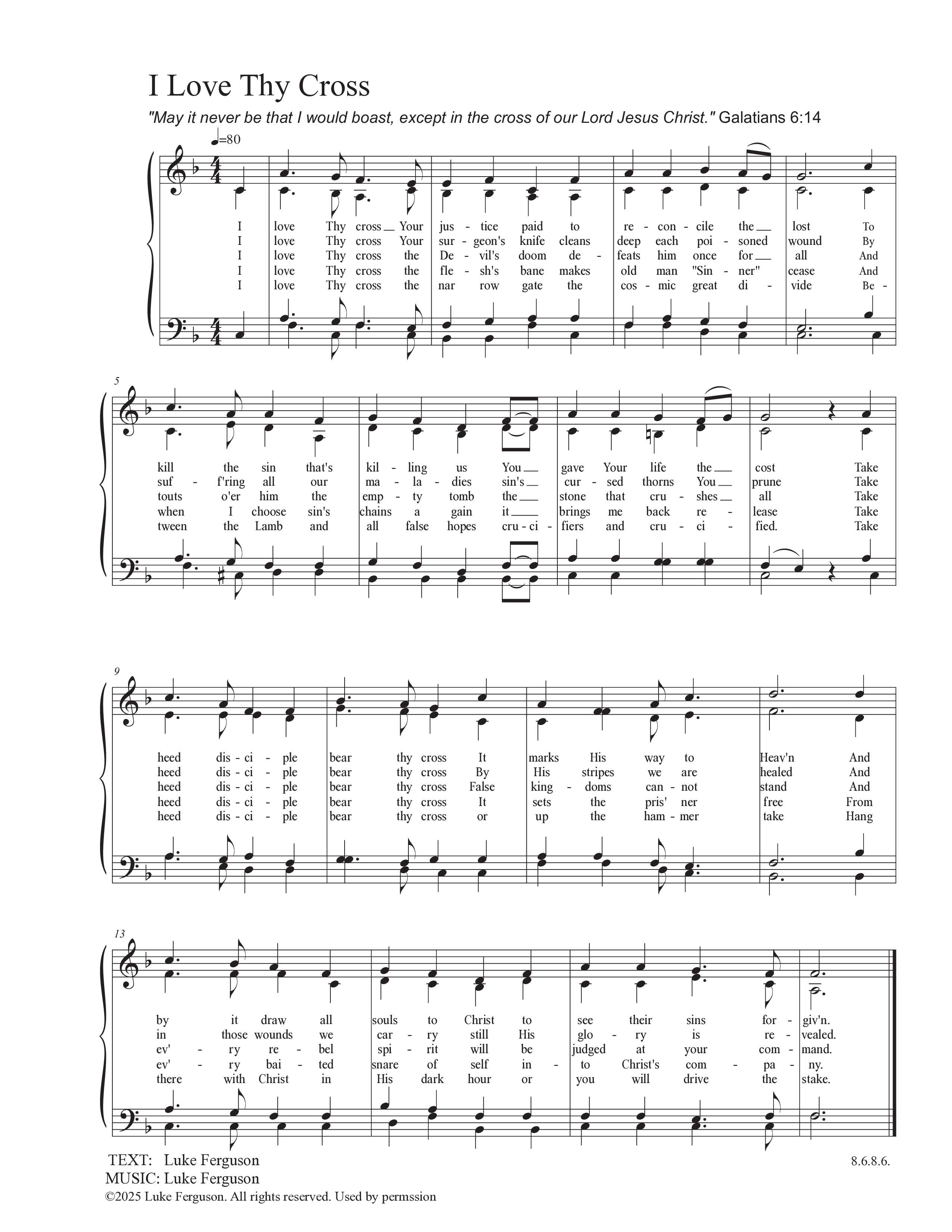
A musician picks his or her notes for various reasons: I chose mine for the intro, turnaround, and outro for these reasons, among others. And Christians let the word of Christ dwell richly in them, I hope some can take inspiration for their own melody-making in their heart to the Lord.

The Higher Melody: The Lord of Heaven has set the pattern for us to emulate here on earth.
Repeated an Octave Lower: This is the pattern as we walk it here on earth.
Middle C: The place all students of the piano start, symbolizing that this is as basic to the Christian life as Middle C on the Piano.
The 7 tones: 7 is a number symbolizing completeness.
Resolving to the Tonic: Even though the melody jumps high and low, it comes back to the note in the middle of the five notes, which we also discover as we listen is the gravitational center of the music. Even so, the Cross is where high and low meet and find that this is ground zero for the new Kingdom.

When you listen to the melody, you may now hear more of the meaning that was put there, and when you look at the Cross of Christ, I hope you will see more of the meaning that has been put there. Also, the song’s meter is a common meter of eight syllables followed by six syllables and eight and six again. (8.6.8.6) It makes it easy to sing together, put other melodies to like “Amazing Grace,” or “Auld Lang Syne,” and to memorize. May the message of the cross be kept in a common enough meter for all mankind to sing it as one. This anthem was written for the whole church. May His body be fully gathered to carry His cross for the lost world, who desperately needs to know His sacrificial love in human form—the reason for which Christ Jesus came in the first place.

In Galatians 6:14, Paul said, “But may it never be that I would boast, except in the cross of our Lord Jesus Christ, through which the world has been crucified to me, and I to the world.” For the Christian, there is nothing else to boast of. When you consider the richness of the word of Christ, it indeed dwells in you and inspires song, hymn, and spiritual song! Even nations unsubmitted to the Gospel reign of Jesus are moved to song by His victory of humble love. Far be it from us that we should boast in anything—any gift, any program, any wealth, or prowess. But thy cross is thy boast: for this we have embraced is the only fitting requisite for the resurrection crown of glory.

And so I leave it with you: The Word of the Cross. “The word of the cross is foolishness to those who are perishing, but to those of us who are being saved, it is the power of God.” (1 Corinthians 1:18) This Word is sufficient to effect exhortation, justification, restoration, emancipation, liberation, polarization, and inspiration. Reinterpret your whole life according to the cross, take it up and follow Him, and O the blessing it will be to the world and to you in Christ! Let’s just say, you too will have before you the same “joy that was set before Him.” (Hebrews 12:2). And what does God’s word in James 5:13 tell him who is joyful to do? “Let Him sing praises.”

Reflection Questions:

  • Which verse of the song stands out the most to you in your life right now?
  • What other aspects of Christ’s work of the cross could be added to these five?
  • What other melodies could you use to sing this song?
  • Write your own song expressing thankful praise to God for His saving work at the Cross, and share it with your brothers and sisters.
Day 3: Verse 2—For the Broken Christian, Restoration

I love Thy cross, Your surgeon’s knife cleans deep each poisoned wound
By suffering all our maladies, sin’s cursed thorns You prune
Take heed, disciple, bear thy cross, by His stripes we are healed
And in those wounds we carry still, His glory is revealed

I hope to shepherd the hurting with this verse and the Cross’s restoration. The profound significance of the cross’s impact is vitally important to the Gospel because every one of us has been wounded beyond our own repair, and not one of us has been wounded as deeply as Jesus. This is difficult to accept, especially for those who are still going through the anger, depression, and soul-sickness that our wounds bring. Here, I hope to offer you a light for your journey in this dark tunnel.

When Jesus died upon the cross, He took upon Himself all the brokenness and wounds of all the world—the verbal, emotional, and physical abuse of close and distant enemies who were supposed to love him. In a moment in time, He showed what the Father has endured for millennia. The more you look at the grotesqueness of what He endured there, the more comfort there is in what you endure. But like those bit by the serpents in the wilderness in Numbers 21, the only way you can be healed is by choosing to look up at Him on that cross, and look hard.

Every blow He took was for your healing, and the healing of the ones who wounded themselves by hurting you. He experienced the depth of life’s sorrow and loss to be with you in the depth of your own loss and sorrow. He did not cheapen it, like some who pass over the cross to the resurrection. He didn’t let what He experienced be forgotten. His glorified body still bore the marks of His betrayal, His agony, and His humiliation. But now victorious, these scars bear a greater glory in life eternal. His story is immortalized not only in our memories but in His own body at the Father’s right hand, interceding for us still.

And for the suffering to come, He also offers greater grace. Sin’s cursed thorns tear at every aspect of our lives—relational, physical, mental, emotional, spiritual, but they are no longer rampant or unchecked. There is a bottom to the abyss from which He arose. There is a refuge in the thicket where the animals hide in safety. There is a cleft in the rock. And because Christ’s suffering came to mean so much forever, there is joy and hope for us that our stories will result in something greater, something more truly glorious that presently makes no sense at all. But this can only be if we are willing to commit our wounds on our own, our suffering for others’ sake, our unconscionable memories to the Lord, and trust Him to bring about something good. As Joseph told his retribution-fearing brothers, “As for you, you meant evil against me, but God meant it for good in order to bring about this present result, to preserve many people alive.” We won’t be told why, but we will be shown His glory when we see and touch His wounds in person at last. Until that day, let our hearts be kept tender by recognizing His suffering, so we can recognize and sympathize with others in their suffering, so that they might see the glory of total trust in Him ablaze in our still-beating hearts.

Reflection Questions:

  • What have you suffered that you feel like nobody else can understand?
  • What makes it hard to look to God when you’re hurting?
  • In what ways have you seen God bring good out of the terrible things you have suffered so far?

Day 2: Verse 1—For the Private Christian, Justification

I love Thy cross, Your justice paid to reconcile the lost
To kill our sin that’s killing us, You gave Your life the cost
Take heed, disciple, bear thy cross, it marks His way to Heav’n
And by it draw all souls to Christ to see their sins forgiv’n

The first verse is about justification—the jewel in the crown of Reformation Theology. It is at the very heart of the gospel itself and the most notable and essential work of Christ on the cross—the payment for our sins and the making us right before God by grace through faith. Any song about the cross would be replete without this glorious world-turned-upside-down significance of this singular historical moment. “He Himself bore our sin, in His body on the tree that we, having been dead to sin, might live to righteousness.” Romans 3 is a wonderful part of Paul’s theological treatise on how this works: from our sinful estate to God’s free gift of salvation in Christ Jesus. The verses I will highlight here are verses 23-25, “For all have sinned and fall short of the glory of God being justified as a gift by His grace through the redemption which is in Christ Jesus; whom God displayed publicly as a propitiation (or valuable sacrifice) in His blood through faith.” This means that there needed to be a sacrifice made to pay for the sin causing us to fall short of His glory, and Jesus willingly offered Himself as that sacrifice for all who have faith in Him.

He had to take our sin into His body to become sin for us, so that the sin which kills us (Romans 6:23) may be put to death. And no one could pay that cost or can pay that cost except the one through whom, for whom, and to whom are all things: Jesus Christ, God incarnate. What a wondrous and glorious mystery!

The implications for a Christian for why they must carry their cross are these: Jesus left His people here on earth to carry their cross and follow in His footsteps so that:

  1. People could see Jesus’ work in a fresh and living way in His people, in whom Christ is formed.
  2. People can see that true freedom and release are not the absence of suffering, but fully entrusting oneself to the One who makes a dry-land pathway through the river of death.
  3. It is in dying daily that we are daily reborn to eternal life until He comes again.

There is little in this world more distasteful than a “Christian” who is unloving or selfish. If only we could learn to lay down our lives in love for others the way Jesus did on that cross for us. Christ indeed showed us the humble way of total surrender to the judgment of the Father, not for His own sins, but for the sins even of His enemies. This Love is the only love that breaks the power of sin and death to blind people from recognizing the God in whose image they were made. A Christian, by the Holy Spirit’s power, can love like this, and by his or her love draw people to experience the transforming love of Christ. Perhaps as more Christians do this, the less deconstructionism, church-hurt, and hypocrisy we will hear about, and the more baffling, unexplainable grace will draw souls to Christ so they might see their sins forgiven in Him.

Reflection Questions:

  • Tell the testimony of how the gospel has changed your life. Then check: did it include your sinfulness, Christ’s sacrifice, and your acceptance of Christ as your Lord?
  • How have you encountered Jesus in the world? Through whom have you experienced His love?
  • How might your relationships with others be impacted if you lived sacrificially for them, instead of for your own sake?

A Man and a Tree

From ancient time they stood a-post
Planted by the same Wise Hand
From the ground sprung at once gnarled yet smooth
Extending arms ‘neath Heaven’s dome

A ruler brought a seed from home
Planting it near Freedom’s booth
For years it took full shape on land
Immortalized on minted toast

But the beloved son’s time came to an end
The strong shape kept it’s sheltering guard
Until off broke the largest branch
The tower loomed unsteadily

Such monuments men prop up readily
Though time’s decay makes honest blanch
But cables can’t straighten the heartless-bark
Of nobility lacking in the faithless friend.

O man, plant new what time has hollowed
Life by the ground must first be swallowed
In time new shade well-balanced stands
Like a man shaped by time’s just demands.

Inspired by This article about Andrew Jackson’s Tree being replanted.

“Have You No Decency?”?

This news article from this past Tuesday, March 11, 2025, on Straight Arrow News contextualizes the title of this essay.

The question of the question comes repeatedly to my lips as I marvel at the collision of two worlds over my head in that government chamber. One World is a place in which there are only two genders designated by God, and so the most respectful thing is to call people by the gender of the body God gave them. The Other World is where human beings have the right to determine their own identity and to expect that fully informed, well-adapted human beings will address them according to that self-declared identity. The point of contact of this collision is encapsulated beautifully in this word “decency.”

The cursory Google definition that popped up on my phone for this word is: behavior that conforms to accepted standards of morality or respectability. This definition lays out the trajectory for collision between these two worlds: behavior that conforms to accepted standards of morality and respectability. These two worlds of the representatives from Massachusetts and Texas do not have an accepted standard of respectability to conform to. The result in this issue is that so long as there is no agreement, there is no decency to be had.

Or is there?

One is doing the most respectful thing they know by calling a transgendered representative by the title of their gender given at birth because God gave them that gender. The other is doing the most respectful thing they know by correcting someone who is not recognizing a representative’s own personal designation in this public government setting. Personally, I chuckled at the actual representative’s response referring to the Texas male delegate as, “Madaam Chair.” While it was not “decent” for that human being to do so, it kept the dialogue going, because there were more important things to discuss. Perhaps that is all we can do.

Or is it?

I watch these worlds collide and recognize my own place in one of them. One world was created by a loving God, the Other World is created as an imitation by God’s human offspring whose relationship with the Creator is estranged and hostile.

And despite what some may say, I propose that this estrangement is not the Creator’s fault. I think the fault lies at the feet of those who claim to be that Creator’s “ambassadors of reconciliation.” Their lack of willingness to carry Christ’s cross is the reason this Other World persists so, spinning on an axis centered upon the self as the highest god: because there has been so little vision of the True God represented as a New Humanity.

It is not a sad fact that only one of these two worlds will last longer than the other. After all, the way of renewed life is the One World, not the Other World. What is truly sad is that the citizens of the One World are not inclined to lovingly pursue the citizens of the Other to the point of laying down their lives for them. Decency can only exist in the One World and not the Other, because the Judge at the center of the One world is not fickle and imperfect like self, but rather is fundamentally and perfectly compassionate and inexorably justice-oriented.

I just wish that more citizens of the One World understood what “justice” means. Jesus knew, and he showed us that it looks like a cross: A cross surrendering the precious self to abject humiliation for the sake of others because the whole of all our sins merits such a gruesome spectacle.

This is the offensive glory of the cross by which only the humble can be transformed. But those who are transformed, after these two worlds are finished obliterating one another, will find an eternal place in the New Heaven and Earth where righteousness dwells. This transformation is necessary because the One World and the Other World are both doomed, and those in the One World, though it be stronger, will not escape the wrath to come unless they go the way that Jesus paved out of both of these two worlds: the cross. The cross that says, “I lay down my own identity (in the right or in the wrong), and submit to God’s desire and design to love those who do not deserve it.” And to the tender heart I think this, dear reader, better represents the true meaning of “decency.”

Some tips I’ve learned to rule my Imagination

People today struggle a lot with various mental disorder. (notice I didn’t say disorders) Disorder in the brain meaning, things not being ordered in our thoughts, (formulation of ideas) imagination (playing out of pictures and scenes and stories in our minds) and internal worlds (the way we perceive, process, and respond to the world around us). There are ways to gain order in these realms that are not actually that difficult if you’re a Christian. If you’re a Christian you’ve got someone living within you that is actually strong enough to handle them and can strengthen you to take charge of your inner world. After all,

“The Spirit of a man is the lamp of the Lord, searching the innermost depths of his being.” (Proverbs 20:27)

The Holy Spirit can influence our spirit to search the depths of our being, so that every “thought can be captive to the obedience of Christ” (2 Cor 10:15) Not many people do this for a variety of reasons.

  1. They don’t know they can. It’s like when people say “Don’t think about elephants” but you have to think of elephants in order to figure out what NOT to think about. There are ways that you can deal with lasting scars and images and things you wish you could just put away. It is possible.
  2. They don’t know how. They try things but they don’t know for sure if they’ll work. Example: They try to distract themselves from thinking about things. That works short term, but what about when you’re lying in your bed, and your thoughts are decompressing? How do you “shut off the voices”?
  3. They are afraid that their thoughts or imagination will overwhelm them. Some people have trouble dealing with silence for this same reason. They don’t want to face certain things, so they expend so much energy trying to get away from themselves, and the voices they cannot shut off.
  4. They think they shouldn’t. People think, “This is just the way I am. I have to surrender to this.” And so they just let things play out. I think this roughly the equivalent of letting a street gang pillage a city with no protection any time they want. The street gang does not belong in this city, and so we need to establish Law and Order so that thoughts don’t have just any recourse they want in our minds.

On that note, let me continue with the analogy and say your inner world is like a city. Your city needs to be protected and managed. As it says, in Proverbs:

“Like a broken down city without walls is a man who has no control of his spirit.” (Proverbs 25:28)

Now here’s one thing you can do on the front end to manage what comes into the city: Be careful what you pay attention to. Right? If you haven’t paid attention to the News, you won’t be dwelling on that story that worries you late into the night. If you haven’t paid attention to that lovely, beautiful person, you won’t be fantasizing about it later.

But we live in a world that throws tons of stuff at us, and we can filter some of it out, but not all of it. So what do we do with the bandits that get inside our minds.

  1. Acknowledge that they’re in there. Why yes I do have a thought about doing this utterly unthinkable act! Why yes I do think of this person in an immoral light. Why yes I do wish this person would have something bad happen to them. This gets them out of the houses and into the streets. You can’t deal with them until you acknowledge them.
  2. Bring Jesus with you. Jesus has claimed all authority in Heaven and on Earth. That includes your mind, your spirit, especially if Christ’s spirit is in you. Any time you have a memory, or a feeling, you’re using your imagination to play the image of the video tape back, BRING JESUS and put Him in the picture and video with you. He’s already there, you’re just choosing not to look at him in the image. He’s the only one who has the power to deal with it. This is part of “In all of your ways acknowledge Him, and He’ll make your path’s straight” (Prov 3:6). So, once you bring Jesus into the picture, watch what He is doing in the picture.
  3. Talk with Him about the image. If you feel shame, that’s good. Just don’t use it as an excuse to run FROM Jesus. Use it as an excuse to run TO Jesus instead. That’s what the shame is good for. Submit the image to His rule.
  4. Ask Jesus to embolden, authorize, empower, and invigorate you. Asking is the prerequisite to receiving. All power, not just some is belonging to Jesus now. He is the broker, and he’s on your side, but you have to ask.
  5. Then take firm control of the imagaination. Turn to the image and emboldened, authorized, and empowered by Jesus, take control of that image. Example: Say you have a lustful fantasy about someone. Right in the middle of what ever they are doing, put Jesus right there in the room, and start to do what He would do in the imagination. Push the person away, and take a blanket and throw it over them. Sit them down, and explain to them (as if they were a real person) why you can’t do this to them. Put your heart and soul into it. What this will do, is it will rewrite in your imagination the significance of what the flesh wants to get out of it, and rewrite it into what the Lord God actually wants for the situation. It will not only tell your head what to think, but allow your heart to feel the emotions needed to heal.
  6. Test the image again and see if it still has a draw or “power” to you. If it does, go to Jesus, and examine the emotional, spiritual, or mental aspects of the image that seem to have a pull on you.
  7. Take the image in your hand and cast it into something to represent giving it to Jesus. I like to use the Cross, taking nails and nailing the image like a cloth or a creature to the cross. Or sometimes a filing cabinet labeled, “Sanctified images.”

That is how you deal with one thought. Chances are, when you bag these gang robbers, they will scatter and multiple other things will pop up. Deal with each one as efficiently, passionately, and aggressively as you can, until your mind can focus on one image of the Cross without it getting fuzzy. Don’t let it overwhelm you. It’s not forever. Eventually, your imagination will be under your own control.

“He will keep him in perfect peace whose mind is kept on You because he trusts in You.” Isaiah 26:3

It only works if you trust Him.

A Guide to Reconstructing Christian Faith Part 4–God’s Breath

If you’re still listening and looking for more, yes, there is more to being a Christian than the three previous posts. Some Christians will get a little bit nervous here. After all, You’ve got the Person of Jesus Christ, you’ve got the Word of God, the Scriptures, and you’ve got the Spirit. What more could you ask for?

In a word: direction. What do you do with all of this? Are you just . . . in? Are you a Christian and that’s all there is to being a Christian? Is it all just meeting a Person, knowing a Story, and receiving a Spirit?

No. These are just the beginning, and the root system of a tree that has only begun to grow. Tree’s don’t do Heaven all that much good, but it is through growing toward heaven that they become trees that bless more area of the earth. The Tree of Christianity begins with growing Heavenward. In other words, once you become a Christian, you need an orientation to your new life.

I have met Christians who say, “You’re saved so now, all you got to do is pray, read your Bible, and tell other people about Jesus.” This to me is unattractive, over-simplistic and non-compelling. This illustrates a life that if I have met Jesus for real, have been swept up into His story, and filled with a death-conquering Spirit, honestly feels quite anti-climactic and purposeless. What is a Christian saved for? Just to tell other people so we can all be good little “Christians” who are good and know our Bible by heart and are nice to people?

No. The Christians journey to full growth is patterned after Jesus’ journey. And look where his journey led him: to a cross. Didn’t Jesus Himself say, “If anyone would follow me, let him deny himself, take up his cross and follow me”? The life of a Christian in name only does not care to carry a cross anywhere. They’re out for their own salvation. This is no evidence of Jesus’ Spirit living in them.

I have not met many Christians who put it this way, “You’re saved, so now get training on how to carrying your cross, because one day you’ll need it.” And yet, a Christian should expect not only tribulation but persecution. Not only persecution, but opportunities to suffer along with Christ, and be obedient in the way Jesus Christ was– to death, even death on a cross.

Prayer, Bible study, and evangelism are all part of the training process of carrying your cross, but some key elements should be included as well. These I will mention for now.

  1. Being led by the Holy Spirit,
  2. Fasting
  3. Casting down anything in life to which your heart is devoted more than to God.

All that is in our lives that keeps our old-pre-Christian life alive will motivate us to get peel us off the cross the moment we get near it. The Christian-ese term for this is often called “Putting to death the old man.” But it often takes the form of sputtering attempts at being more holy, but ends up making a believer more discouraged or ashamed or entrapped in other sins.

So, we have all we need for the journey: Jesus Himself, His Story, and His Spirit and the expected destination for this journey is a nebulous word called “the cross.” I truly haven’t summed it up yet, but I’ve hinted at it. Rather than immediately answer the question “Why does death on a cross, literal or figurative, equal obedience to God?” I want to give you some time to figure that one out. Instead, I’ll review that the putting to death of the old man, in the form of fasting, being led by the Spirit and casting down all other heart devotedness. Now let me answer the question: how does one do that?

A tad-pole breathes water only until it comes up on land, then it uses its lungs as its primary source of oxygen. A Christian is like a frog. He can go back into the water, just like the frog, and live in it, but he needs to learn to use these lungs. That means instead of relying on earthly sources of life, lean on heavenly sources of life. Instead of being led by your own desires, be led by the Holy Spirit’s promptings. Instead of feasting on earthly food, drink, and pleasure, feast on God’s Word, God’s presence, and the pleasure of His presence. You’ll find alot more oxygen in God’s presence than any pleasant place in the world. Instead of letting your heart get energized in pursuit of anything in this world you love, let the heart melt for God above all, and let your affections be stirred by the Highest and greatest object of your heart’s desire. A Christian needs to learn how to do this, so that always everywhere, he will be empowered to walk in the same world, but being empowered by the Breath of God.

One more thing: remember how this is not all hokey impersonal spirit stuff? We were designed for relationship with God. Our primary, our most essential, our most important relationship is with the Lord. This is the essence of what it is to be a Christian: to live in communion with God in Jesus Christ. He who saves you, draws you to know Him more, and this relationship with Him is eternal life.

He who has ears to hear, let him hear!

Sabbath

Out the window, I see the sky and remember
Your sun brightens eyes like no electric ember
Even in the night’s canopy I ponder
The stories You tell in the stars beyond.

Caves, roofs, and trees all shelter
Me from the rains of inconvenience and disaster
But once a week, O just to seek
The sky to remind my eyes so weak
That though life’s shadows may be bleak
There is rest for those who shirk pride; who are meek

To shoulder no burden save the air
To bear no care but the sunrise
To soak in the cool spring of all that’s fair
And be drawn deeper into Your eyes.

Parable: Two Temples

Once upon a time in a great kingdom far away, there was at the center of the realm, a Temple. This temple was immense, and it was also a garden. Fruit trees, cherry blossoms–a self-sustaining eco-system where the animals and plants all produced and flourished with life. It was tended and kept by watchful guardians, and it was perfect.

Then one day, someone came and dumped a ton of trash in the center of the garden. The keepers of the garden were devastated and since they didn’t know how to deal with the trash, they left it there. And the trash started to mess with the ecosystem and make it fester. It started to pollute the whole garden until it overran it. People abandoned their care of the garden, and they abandoned visiting the temple, but their hearts still hungered for the beauty of the temple.

So they started building temples of dead things, and started to put up artificial fruit trees. The people there were all very friendly, but they had only one rule: you had to call the artificial trees, “real fruit trees.”

One day a visitor from a neighboring kingdom came and visited the realm, and went to the temple they had constructed, and he remarked to them all, “What is with all the fake trees?” The people politely corrected him since he was a stranger, “They aren’t fake, they are real.” And he said, “No they’re not. In my kingdom, our fruit trees bear real fruit and you can eat them. This is not a real fruit tree.” Impatiently, they said, “Well, when you are in our kingdom, you will call these real fruit trees. If you don’t like it you can leave.” And he said, “What about the garden at the center of your kingdom? Don’t you have real fruit trees there?” At this they grabbed him and kicked him out of their temple and said, “Don’t come back here again, if you’re going to treat us so disrespectfully!”

Scratching his head, the visitor went to the center and saw all the trash littered there, and he started to call people in the kingdom to help him clean it up. A handful of them worked together until at least a small part of the Garden looked like it did before. Then he brought to them the fruit from the center of the Kingdom, and offered it to the people in the “Artificial Temple.” Of course they had some type of fruit, but it was imported and borrowed and as artificial as the trees, but not nutritious. He offered the fruit to anyone who would take it, and when he handed the fruit to someone who accepted it, he called the fruit a word which they did not understand at first.

Sacred.